 MORPHO
1. Software distributions
Morpho 2.1.0 runs within Rhino and Grasshopper. Both packages include setup and manual installation folders for Rhino 7 and Rhino 8. Rhino and any analysis dependencies must be installed separately.
Setup applications are distributed without publisher certificates. Consult the installation instructions for first-open prompts and manual installation. Rhino 7 uses Rosetta on Apple Silicon.
Installation instructions · TXT / Software guide · TXT
Before a study. Verify a complete generate–save–review cycle on your system. Keep your model, analysis dependencies and project data together. See the workflow documentation for setup and data-management details.
2. User manual
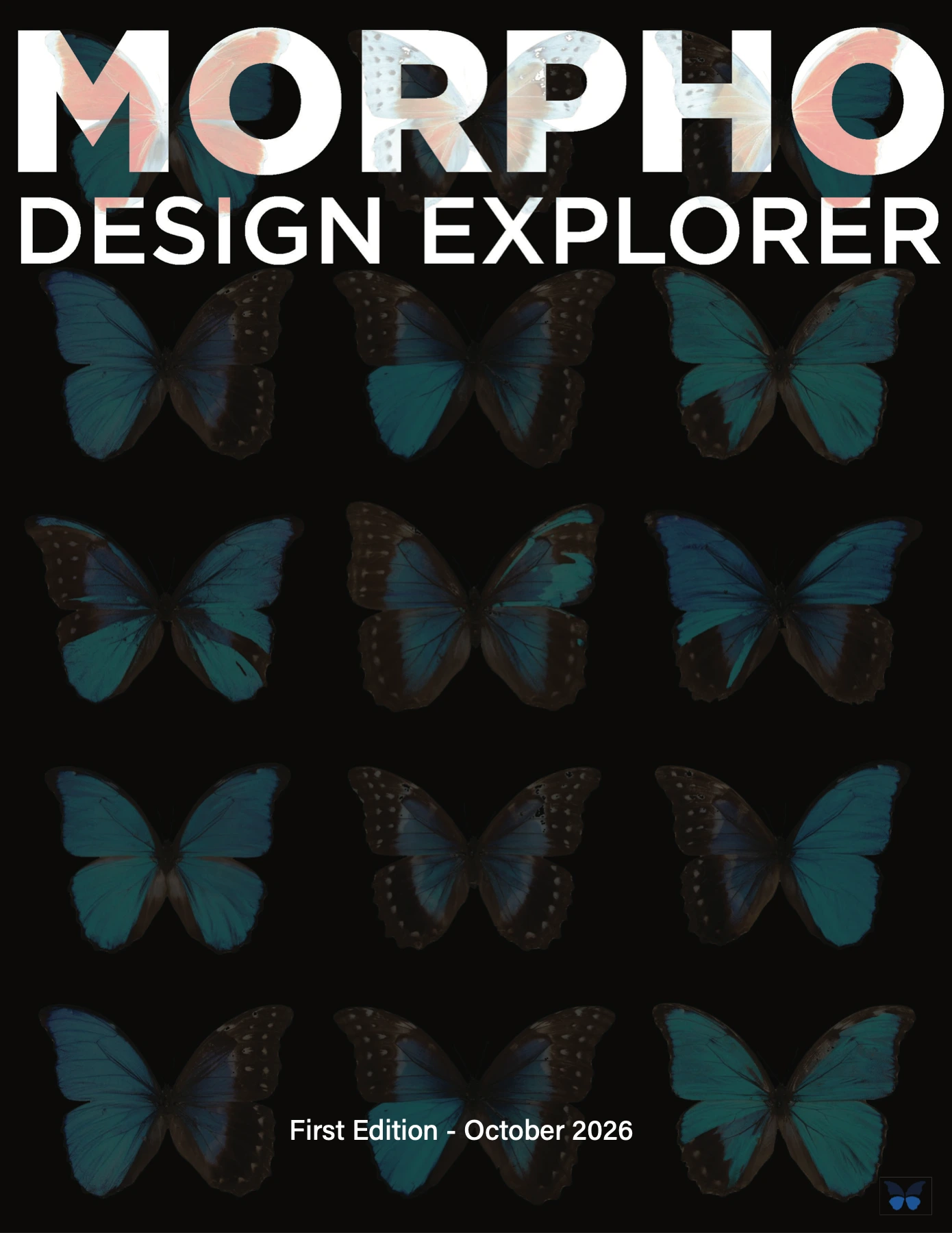
Morpho 2.0
User Manual
Anahita Khodadadi
First edition · October 2026
35 pages · PDF
Project background, the exploration method, component workflows and visual analysis through an arched-truss example.
Open the complete manual ↗This is the original document hosted on this website. Its published 2.0 title is retained; the component reference describes software version 2.1.
Zenodo record ↗Read the PDF within this page
3. Publications and citation
The following research provides context for Morpho’s designer-directed exploration approach. The paper and the software have distinct scopes: the software does not implement an automated TRIZ problem-solving engine.
Design exploration by using a genetic algorithm and the Theory of Inventive Problem Solving (TRIZ)
Khodadadi, Anahita, & von Buelow, Peter (2022).
Automation in Construction, 141, 104354.
DOI: 10.1016/j.autcon.2022.104354 ↗
University at Buffalo publication record ↗
The paper examines GA+TRIZ as a method for structuring design problems and considering quantitative and qualitative goals.
Morpho 2.0 User Manual
Khodadadi, Anahita (2026). First edition, October 2026.
View BibTeX references
@article{khodadadi2022design,
  author = {Khodadadi, Anahita and {von Buelow}, Peter},
  title = {Design exploration by using a genetic algorithm and the Theory of Inventive Problem Solving (TRIZ)},
  journal = {Automation in Construction},
  volume = {141},
  pages = {104354},
  year = {2022},
  doi = {10.1016/j.autcon.2022.104354}
}

@manual{khodadadi2026morpho,
  author = {Khodadadi, Anahita},
  title = {Morpho 2.0 User Manual},
  edition = {First},
  year = {2026},
  month = oct,
  doi = {10.5281/zenodo.23477542}
}
When reporting a software-based study, also state the Morpho version, Rhino version and analysis dependencies actually used. The manual citation does not identify those details for your experiment.
4. Documenting a study
The saved population provides an inspectable record of alternatives. Preserve the full project folder, not just the exported table, so numerical results remain associated with their images and textual files.
- Model: retain the Grasshopper definition and all dependencies.
- Variables: report parameter names, units, bounds and precision.
- Evaluation: specify analysis assumptions, objective directions and feasibility checks.
- Runs: record iteration limits, mutation and spread settings, parent IDs and selection expressions.
- Interpretation: retain plot settings, selected alternatives and the reasons for each subsequent exploration.
5. Attribution and terms
The manual identifies Morpho under Creative Commons Attribution–NonCommercial 4.0 International. Consult the published license for your intended use. Installation packages contain notices for bundled third-party libraries.
Manual figures reproduced on this website are attributed to Anahita Khodadadi (2026). The geometric study on the overview page is an original explanatory diagram, not experimental evidence.
Project questions: morphodesignexplorer@gmail.com
Research contact: akhodada@buffalo.edu